
No Time to Prepare: Delphine on the Ripple Effects of USAID’s Withdrawal in Northern Tanzania
By Delphine Mselle, EngenderHealth Tanzania
When USAID abruptly withdrew support from key reproductive health programs in Tanzania, the consequences went far beyond funding cuts. For EngenderHealth’s Delphine Mselle, the loss wasn’t just about resources—it was the sudden collapse of a system USAID had spent decades helping to build, and that had impacted the lives of communities across Tanzania.
Delphine Mselle has spent more than 16 years with EngenderHealth Tanzania, leading programs that have transformed how communities in northern Tanzania access reproductive healthcare. As a Zonal and a Regional Coordinator for the Scaling Up Family Planning project, she oversees work across Arusha, Kilimanjaro, and Tanga—strengthening quality care, supporting the availability of quality data, and ensuring services reach those who need them most.
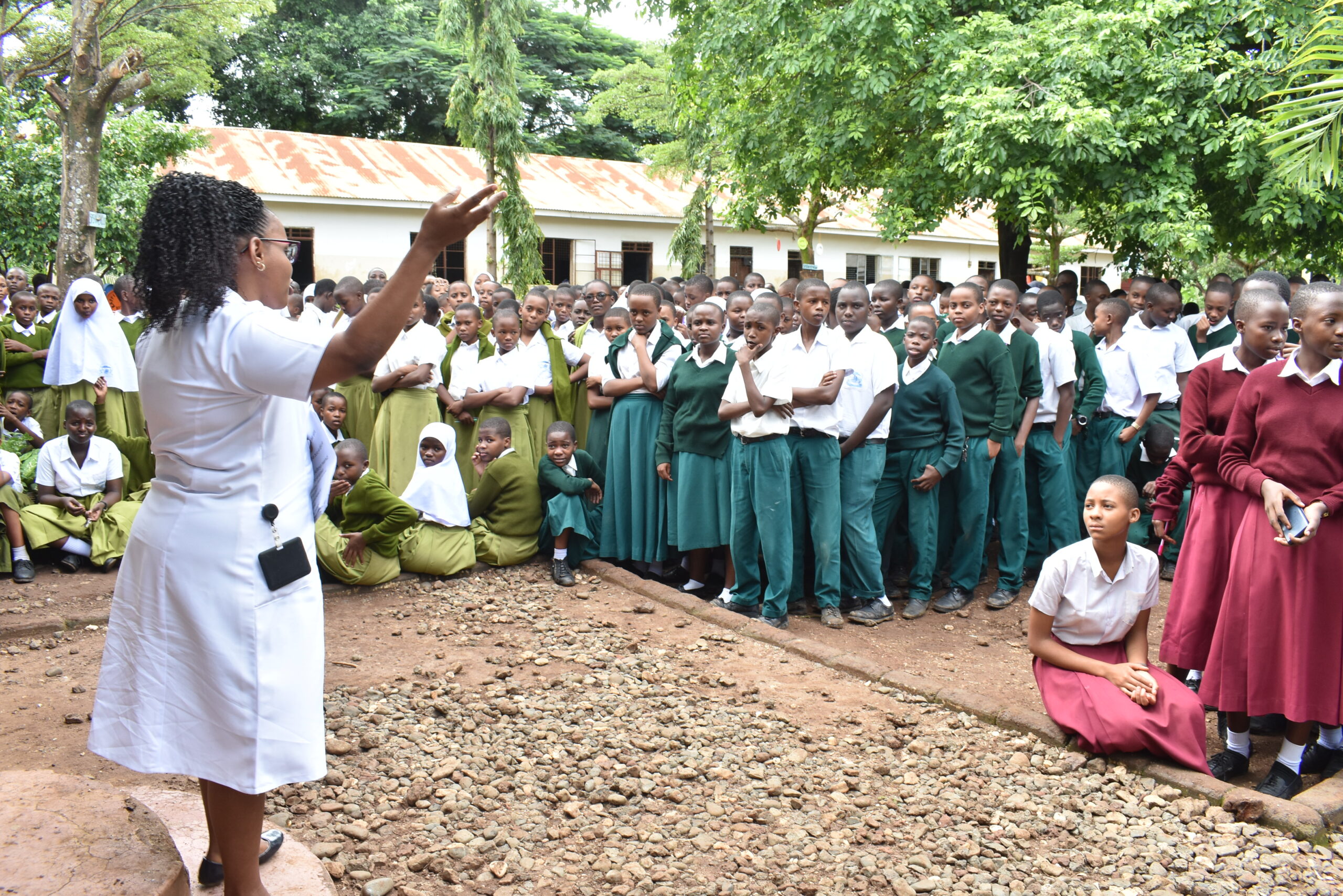
A healthcare provider speaks to secondary school students about reproductive health during a school outreach session supported by EngenderHealth’s Scaling Up Family Planning project in Tanzania.
Over the years, she has witnessed how a well-functioning health system depends on strong infrastructure, trust and coordination, and a shared purpose.
USAID’s longstanding support helped nurture and sustain this coordination over many years—funding not only services, but also the relationships, systems, and skills that made care delivery consistent and responsive to the community.
So when USAID abruptly withdrew support in early 2025, she watched as programs and partners she once worked alongside begin to unravel: their services halted, activities ceased, and communities left without options.
“They supported people, systems, and communities,” Delphine says. “Everything used to connect—like bringing implementers together at meetings or doing joint reviews and coordinated physical visits to health facilities. Now, these visits to the communities are lagging. We had built so much trust, and now so many parts that used to work together are suddenly missing.”
A Sudden Exit, With No Time to Prepare
What makes this hard is how abruptly it happened. USAID’s exit didn’t come with a roadmap or a transition plan. It wasn’t slowly phased out. It was immediate.
“They took their hands off everything in a single second,” Delphine remembers. “No one had time to think, to re-plan, to adjust. It was all just gone.”
That sudden exit left the Ministry of Health, clinics, and communities scrambling: immediately cutting off services, laying off staff, and watching hard-earned progress go in reverse.
“We’re doing our best to adapt,” Delphine says. “But our partners can’t fill these gaps overnight. USAID supported everything—from equipment and training, supervision and data collection.”
Watching the Ripple Effects
Programs that once complemented and reinforced each other are faltering. The system simply cannot absorb so sudden a loss. As a respected leader in Tanzania’s health sector, Delphine is confronting this reality firsthand as she works tirelessly to sustain progress and support her colleagues amid growing challenges.
In recent weeks, she has witnessed health clinics that once relied on USAID-supported supply chains run out of contraceptives and HIV test kits. Community health workers who are key links in rural health facilities have been laid off. She has seen supervision and quality assurance processes become less frequent due to financial constraints. Younger health workers are starting to enter the field without the prospect of quality hands-on training, and aging equipment is no longer being maintained or replaced.
“It’s like watching a well-functioning system fall apart piece by piece,” Delphine says. “Everything used to connect—now those connections are gone, and the system can’t hold.”
Declining Safety and Shrinking Access
The breakdown of the health system is starting to affect care at every level. The impact on patients has been immediate and severe. Outreach services have stopped. Stockouts are common. IUDs and implants are increasingly unavailable as contraceptive shortages increase.
“The quality of care is declining,” Delphine says. “Without trained staff and proper working equipment, services can become unsafe.”
Lives at Risk When Services Disappear
Delphine has spent two decades working alongside communities across Tanzania. But what troubles her most now isn’t a policy shift—it’s the human impact. The disappearance of USAID-funded outreach services, trained providers, and basic supplies has made even the simplest forms of care harder to access.
“We have to think of a poor woman suffering in the village,” she says. “A woman who walks several kilometers to get antenatal care or family planning. If those services aren’t there anymore, and if the outreach we used to provide is gone, she may find that no care exists anymore. There are no trained staff and no services nearby. She might even bleed out on the way.”
These are the kinds of maternal health emergencies that EngenderHealth has worked to prevent by training health workers, strengthening referral systems, and ensuring that clinics are equipped to manage obstetric complications. These efforts helped reduce maternal deaths and bring dignity to care.
EngenderHealth’s work has always been deeply integrated with the broader health system—partnering with governments, NGOs, clinics, and communities—each playing a role in creating lasting, sustainable change. People like Delphine have seen firsthand what it looks like when the pieces fit together; when coordination leads to care that saves lives. That kind of system takes years to build.
But without USAID’s wider support for the entire health system, cracks are beginning to widen. Staff are no longer available for routine or emergency care. Stockouts of long-acting contraceptives and other essential supplies are increasingly common. And rural communities—where the risks are highest—are being left with no safety net.
“There are really poor people who need this support,” Delphine explains. “Fewer communities are now being reached, and people aren’t getting the care they need or depend on.”
A Legacy that Americans Deserve to Understand
To many people in Tanzania, USAID represented the best of what America could be. It wasn’t just a donor—it was a trusted partner. Its investments built health systems, trained generations of providers, and gave communities the tools they needed to thrive. But for many Americans, that legacy remains invisible.
“I want people in the U.S. to know what USAID really meant,” Delphine says. “Because here, it meant everything.”
Its legacy is still visible in the buildings it helped renovate, the cancer screening machines it funded, the job opportunities it created, and the health workers it helped train. But the true measure of its impact is only fully understood in its absence.
“They made a system that became part of how we delivered care,” she says. “And now it’s disappearing.”
What Comes Next
Still, Delphine holds onto hope. She believes in the resilience of Tanzanian communities and in the possibility of rebuilding, if the world is willing to show up.
“There’s a legacy that remains,” she says. “USAID helped us build a strong foundation. Those things haven’t disappeared. USAID had a great impact, but they moved their hands out too abruptly. With the right support, we can recover and build something even stronger.”
Her message is not just about restoring funding. It’s a call for thoughtful re-engagement based on partnership, dialogue, and shared responsibility. While some of the pieces may have fallen apart, she believes they can be rebuilt again. When governments, NGOs, and communities work together in harmony, they can build resilient health systems that can withstand crisis, restore trust, and save lives.
“We need to sit down together, see what’s most needed, and plan for the future.”
Because what USAID created wasn’t just infrastructure. It was trust. It was dignity. It was a promise that every life matters, especially those who were too often overlooked.
That promise shouldn’t be forgotten.
Thank you to Kate Tibone for sharing Delphine’s story.