
Bringing Safe Abortion Care Closer to Survivors in Ethiopia
By Bekele Ayalew, EngenderHealth Ethiopia
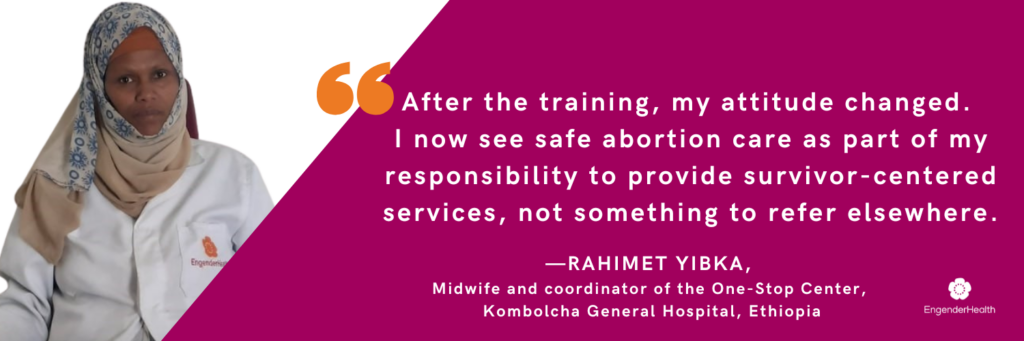
Can training help a healthcare provider rethink deeply held beliefs about abortion? For one midwife in Ethiopia, EngenderHealth-supported training changed both her perspective and her practice.
At Kombolcha General Hospital in Ethiopia, survivors of gender-based violence can receive medical care, counseling, and other support through the hospital’s One-Stop Center. But for years, one critical service was missing: safe abortion care.
The need was there. Some survivors, including those affected by sexual violence, required abortion care. But Rahimet Yibka, a midwife and coordinator of the One-Stop Center, found it difficult to provide that care because of her personal beliefs.
Instead, she referred survivors to the hospital’s safe abortion unit or other facilities. Those referrals could mean longer waits, added costs, emotional strain, less privacy, and another place where a survivor might have to tell her story again.
“I thought referring them was the right thing to do,” Rahimet reflects. “I didn’t see it as part of my role.”
Learning a Rights-Based Approach
EngenderHealth’s training strengthened providers’ clinical and counseling skills and included Values Clarification and Attitude Transformation (VCAT), an approach that helps providers reflect on personal beliefs, examine how those beliefs can affect care, and reconnect with their responsibility to provide respectful, rights-based services.
For Rahimet, that reflection was not immediate. She listened to colleagues, asked herself difficult questions, and considered more deeply what survivor-centered care should mean in practice. Continued mentoring and supportive supervision helped her put what she had learned into action.
Gradually, her perspective changed. Then her practice did, too.
“After the training, my attitude changed,” she says. “I now see safe abortion care as part of my responsibility to provide survivor-centered services, not something to refer elsewhere.”
Rahimet took the initiative to integrate safe abortion care into the One-Stop Center. Survivors who needed the service could now receive timely, nonjudgmental counseling and care in the same place they were already receiving other support.
A Lasting Impact
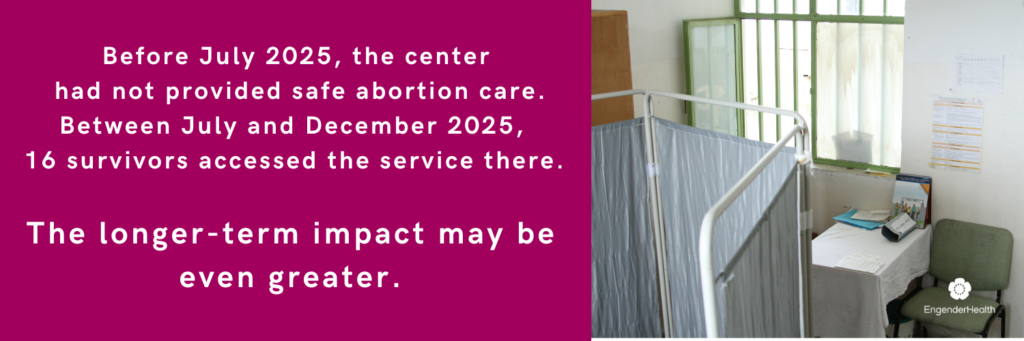
Rahimet did not just change what happened for those 16 survivors. She changed how she understood her role as a provider. That shift now shapes every future conversation, counseling session, and decision about care.
Rahimet’s experience reflects an important part of EngenderHealth’s approach to expanding safe abortion care: building clinical skills while also addressing the beliefs, stigma, and biases that can influence whether people receive respectful, timely care.
Today, what Rahimet once saw as outside her role has become part of how she understands it: making sure survivors who come through her doors can receive compassionate, confidential care without judgment, unnecessary delay, or being sent away.