
Why the Global Abortion Care Movement Gives Traci L. Baird Hope
An interview with Traci L. Baird, EngenderHealth’s President and CEO, on why abortion care is a human right, what respectful, high-quality care requires, and why she remains hopeful about the global movement for reproductive rights.
What does a career spent advancing abortion rights teach you about care, progress, and hope?
For Traci L. Baird, EngenderHealth’s President and CEO, the answer begins with listening to people and recognizing access to healthcare, including abortion care, as a fundamental human right.
Traci began her career as a counselor at an abortion clinic and has spent more than three decades advancing sexual and reproductive health and rights across Africa, Asia, Latin America, and the United States. She has led EngenderHealth since 2018.
We spoke with Traci about the experiences that shaped her commitment to abortion rights and care, what quality means beyond a medically safe procedure, what she has learned from communities around the world, and why she believes progress is still possible.
Why does providing access to comprehensive abortion care matter to you? Could you share a moment or story from your work that reinforces why this work matters?
My first job after I graduated from college, more than 30 years ago, was as a counselor at an abortion clinic. I remember so many people that I met through that work–the doctors who truly cared about our patients, the counselors, nurses, and lab techs who made sure everyone was supported, and individual women and teens who came to us for information, options, and care.
I talked with a teen who didn’t understand that sex caused pregnancy; I talked with a university professor who was so worried about seeing one of her students in the waiting room that she delayed making an appointment; I talked with a woman who was deploying with the military and needed to schedule her appointment before reporting to her unit.
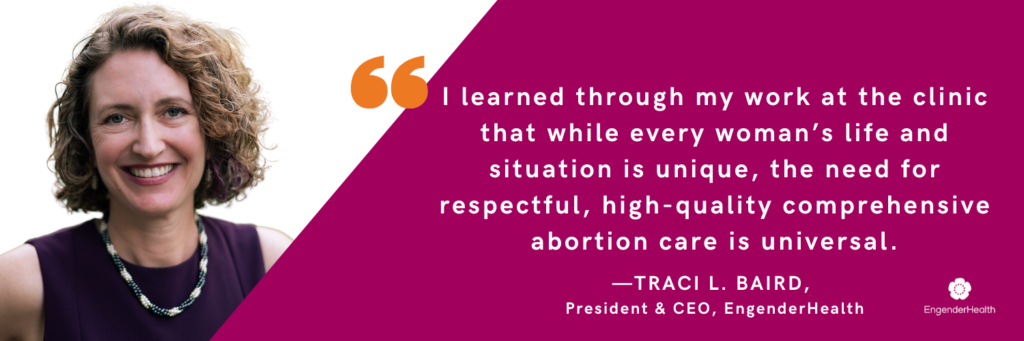
I learned through my work at the clinic that while every woman’s life and situation is unique, the need for respectful, high-quality comprehensive abortion care is universal. I internalized this lesson and have worked on some aspect of advancing access to abortion rights and care in every role I’ve had since.
Topics surrounding reproductive rights and justice are receiving significant attention in the United States today. Why is it important to also pay attention to the global fight for reproductive rights?
Access to healthcare, including abortion care, is a human right. We can’t separate a fundamental right by geography, and we shouldn’t settle for some people having access while others do not.
Strategically, too, we should learn from successful advocacy strategies around the world and connect the global movement, so we are as strong and effective as possible.
In abortion care, what does “quality” mean beyond providing a medically safe procedure? How can healthcare systems better measure and improve patient experience and clinical outcomes?
By definition, high-quality care is effective, safe, people-centered, timely, equitable, integrated, and efficient. In abortion care, this means caring for the whole person. It includes meeting the immediate need to end a pregnancy while ensuring the person is treated with respect, can access care when and where she needs it, is connected to related services, and receives the information and support she wants.
High-quality care does not have to happen in a clinic or facility; it can also mean access to effective medication at a convenient pharmacy at a fair price, along with clear information that helps someone safely and effectively end her pregnancy.
EngenderHealth does a lot to help healthcare systems measure and improve quality of care. I think a key part of it is inviting the community to help define what quality means to them and provide feedback on how care and services are delivered.
You’ve worked domestically in the United States as well as across Africa, Asia, and Latin America. What are some lessons you’ve learned from partnering with communities in these diverse regions? How do you ensure that programs are responsive to local community cultures and needs?
I’ve learned to listen to people–to individuals of all ages, policymakers, healthcare workers, communities, religious leaders, teachers–because people have the answers. Those answers may be in the form of more questions about what’s possible, what has worked elsewhere, or what support they can access.
I’ve also learned to have trust, even when things are unfamiliar. In the first clinical training I attended in Ghana, the midwives who were receiving training began the session with a prayer, asking Jesus to help them learn the skills they needed to save women’s lives. In my experience working at a clinic in the US, which was routinely picketed by anti-choice protestors, people who invoked Jesus were protesting reproductive rights, not learning to provide reproductive health care. I learned a lot in that moment in Ghana and remain grateful for that lesson.
What gives you hope that the future moves in the right direction for global and reproductive health?
I do have hope for the future! It’s important to remember that the past has been moving in the right direction. Since I have worked in this field, more than 60 countries have made their laws more liberal compared to four that have passed more restrictive laws. That’s huge!
I’m also convinced that the current generation of young people, who are almost 25% of the world’s population, will continue this trajectory and demand, build, and support a more just future.
Of course, this hope is tempered by my concern that groups and individuals who oppose rights and choice are bold and well-funded. It’s more important than ever that those of us who stand for rights, equality, and justice work together, however strong the headwinds.
Thank you to Lucy Fishkin for leading this conversation with such thoughtful questions and care.
Explore More on Abortion Rights and Care
Explore more perspectives, stories, and practical resources from EngenderHealth’s work to expand access to high-quality abortion care.
You may also be interested in:
- Meeting Opposition with Action: Practical strategies for responding to antichoice opposition and misinformation.
- Sometimes, Changing Hearts Is the First Step to Saving Lives: EngenderHealth Ethiopia‘s Nardos Bogale on abortion stigma, provider attitudes, and access to care.